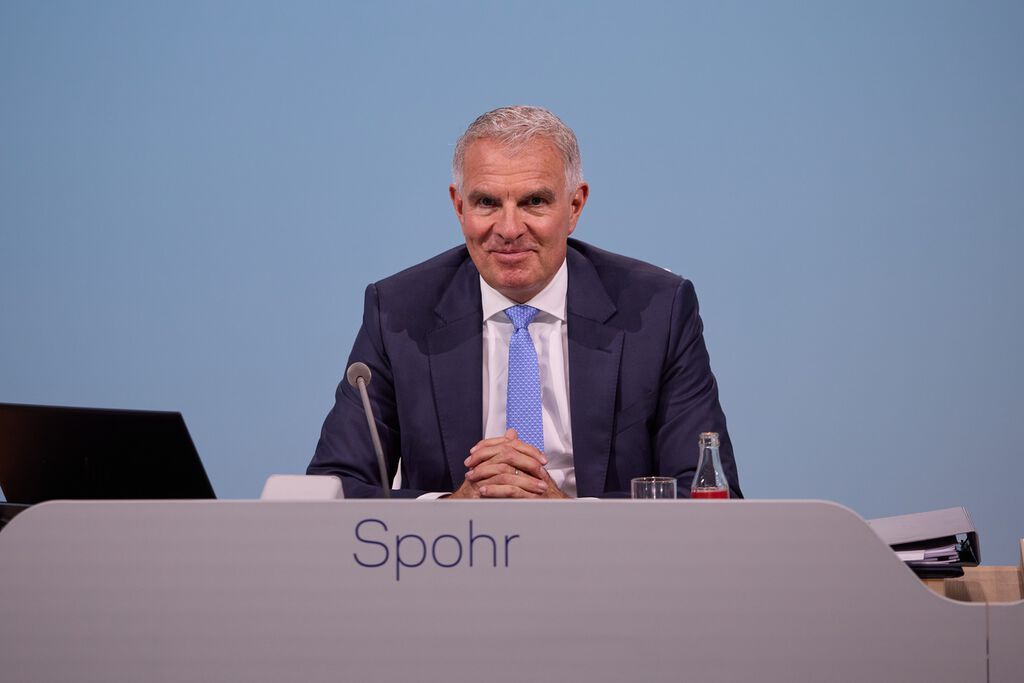
Pax Sentinel - Lufthansa's 2023 Pay Overhaul Lifted CEO Remuneration Cap to €11 Million
Lufthansa Group expanded the upper limit on executive compensation under a revised remuneration framework adopted in 2023, establishing an annual remuneration ceiling of €11 million for Chief Executive Officer Carsten Spohr, according to corporate governance disclosures published in the company's statutory remuneration reports. The ceiling represents an increase from the €9.5 million maximum compensation limit that applied prior to the carrier's governance overhaul. Approved under Section 87a of the German Stock Corporation Act, the revised compensation framework was formally endorsed by shareholders at the group's Annual General Meeting on May 9, 2023, with application to the 2023 financial year. The policy revision arrived shortly after the German government concluded its direct participation in the airline conglomerate. During the COVID-19 pandemic, state stabilization aid barred executive board members from receiving variable bonuses or salary increases. That condition ended when the German Economic Stabilisation Fund sold its remaining 6.2 percent equity stake in September 2022, opening the path for the supervisory board to renew Mr. Spohr's contract through 2028 and expand long-term bonus ceilings. Structure of the Executive Package Under the governing compensation framework, Mr. Spohr receives a fixed annual base salary of €1,634,000, disbursed in twelve equal monthly installments. In addition to this cash base, Lufthansa credits €990,000 annually into a defined company pension account. Variable compensation is partitioned between a one-year short-term incentive and a four-year long-term incentive program. The annual bonus is weighted 80 percent toward balance-sheet benchmarks, specifically Adjusted EBIT and Adjusted Free Cash Flow, with the remaining 20 percent tied to stakeholder metrics. In the 2023 financial year, statutory remuneration awarded and due under Section 162 of the German Stock Corporation Act totaled €4.58 million for Mr. Spohr, with total realized direct remuneration reaching approximately €5.6 million. That figure climbed to €6.2 million in the 2024 reporting period as multi-year variable components matured. Upward Shift in Legal Limits The €11 million maximum remuneration figure functions as an absolute statutory stop on all realized disbursements attributable to a single operating year. If the combination of base salary, pension contributions, fringe benefits, and variable bonuses exceeds €11 million, the long-term cash and share payouts are automatically reduced. The revision forms part of a broader upward recalibration of executive pay caps across the corporate board. The maximum allowable compensation for the group's Chief Financial Officer was set at €6.5 million, while ordinary executive board members saw their statutory ceilings raised to €5 million. Compliance with the €11 million cap for the 2023 financial year cannot be formally closed until early 2027. Because performance shares operate across a four-year measurement window concluding on December 31, 2026, the supervisory board will confirm whether cumulative payouts remained within the statutory ceiling in the 2026 remuneration report. A further increase in the cap remains legally and operationally improbable before Mr. Spohr's current executive contract expires on December 31, 2028. Under German corporate governance law, remuneration systems must be submitted to a shareholder vote at least once every four years, and shareholders affirmed the existing €11 million cap without alteration when endorsing the 2025 system adjustments. With earnings under pressure, any premature revision before the 2028 renewal window would encounter intense shareholder resistance. International Disparities The structure places Mr. Spohr among the highest-compensated airline executives in Europe. His realized annual totals of €5.6 million to €6.2 million slightly exceed the single-figure packages earned by International Airlines Group Chief Executive Luis Gallego (approximately €3.58 million in 2023 and €5.51 million in 2024) and Air France-KLM Chief Executive Benjamin Smith (€4.2 million in 2023 and €5.11 million in 2024). When measured globally, the German executive's compensation trails major carriers in the United States. Delta Air Lines Chief Executive Ed Bastian recorded total annual compensation exceeding $12 million in recent fiscal years, driven by equity grants common in North American proxy statements. Conversely, Mr. Spohr's package substantially exceeds remuneration norms at major Asian carriers. Chief executives at network airlines such as Singapore Airlines, ANA Holdings, and Japan Airlines rarely exceed annual compensation equivalents of $2 million to $4.5 million USD, reflecting distinct regional corporate governance models. Balancing Board Pay and Consumer Pressures The expansion of executive pay ceilings comes amid heightened scrutiny of the airline's operational resilience and pricing policies. The carrier faced sustained public criticism after [EU courts confirmed Lufthansa's €6 billion pandemic bailout was illegal](/en/article/uEAp45WU_eu-court-confirms-6-billion-pandemic-aid-was-illegal) following challenges over regulatory market distortions. At the same time, the airline conglomerate has instituted aggressive cost-containment measures across mainline operations. These efficiency programs expanded as [plunging operating profits prompted further passenger fare hikes](/en/article/YcKwfI86_plunging-operating-profits-prompt-further-passenger-fare-hikes), with the group channeling flights toward lower-cost regional units such as City Airlines and Discover Airlines to trim crew expenditures. In its published remuneration reports, Lufthansa's supervisory board stated that the compensation system provides competitive incentives that align executive earnings with long-term company performance and the standards of Germany's DAX index.