Pax Sentinel - Metadata Exposes Preplanned Subsidiary Liquidation
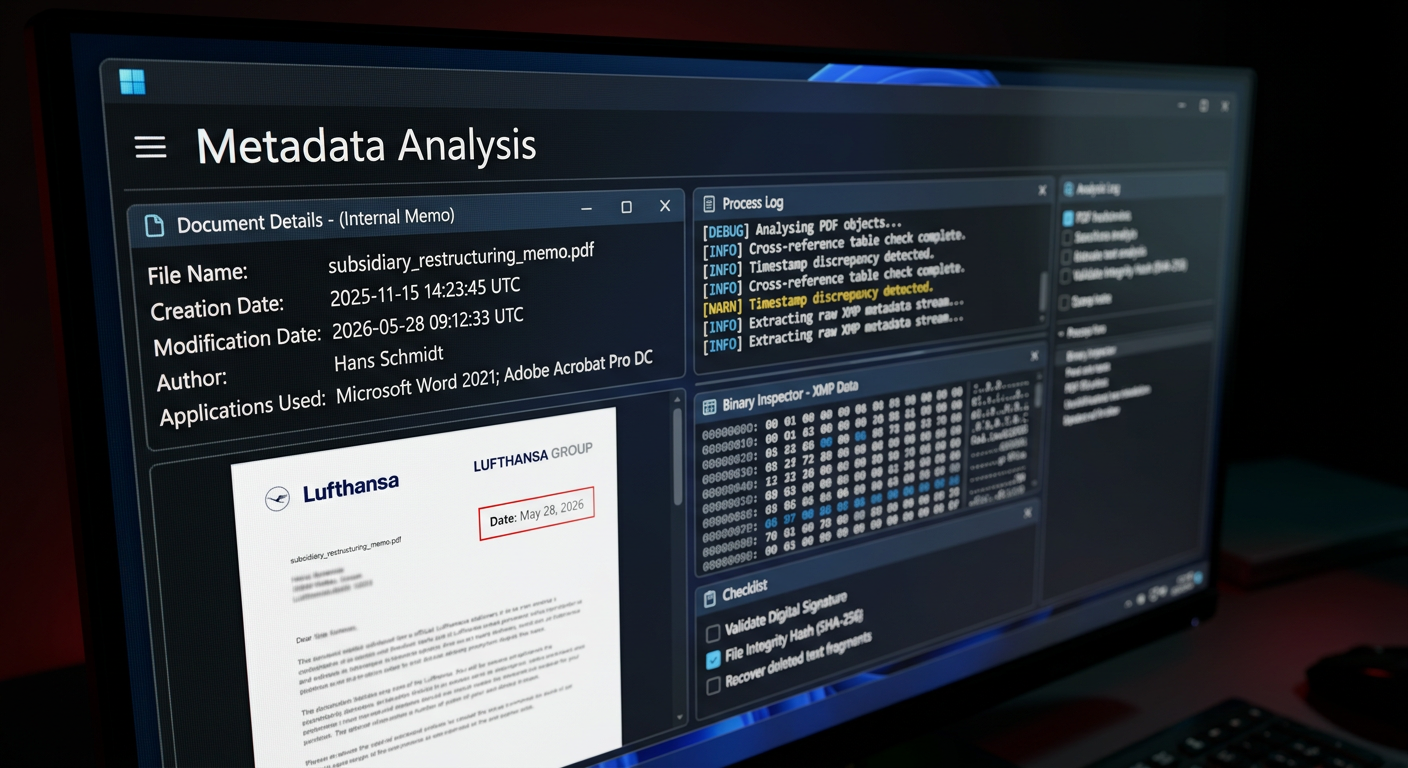
FRANKFURT - Metadata embedded in official communication from Lufthansa Group has revealed that the liquidation of its regional subsidiary, Lufthansa CityLine, was planned at least five months before its implementation, contradicting corporate claims that the shutdown was an emergency response to labor strikes. According to a corporate disclosure published by the cabin crew union UFO on May 28, 2026, the group is now actively negotiating the permanent closure of the regional carrier. This development follows a staff assembly held on May 22, 2026, at the Frankfurt Airport Hilton, where employees confronted executives over the timeline of the operational termination. During the assembly, staff representatives revealed that the electronic file detailing the consequences of the "temporary" shutdown was created as early as November 2025. This timeline precedes the April 2026 suspension of flights by five months. Union representatives said that this five-month margin makes the corporate narrative of an overnight emergency decision highly implausible. When confronted with the metadata, Lufthansa executives said that they had merely utilized an existing document template and neglected to update the file properties. Union officials said that the explanation is mathematically inconsistent with the rapid sequence of events that management claimed occurred on the day of the shutdown. The Paper Trail The union's analysis showed that for management’s public timeline to be accurate, the executive board would have had to notify the works council, brief the supervisory board, cancel cargo operations, produce an internal studio video and calculate the financial projections within a single 30-minute window on April 16, 2026. The revelations suggest that the corporate leadership utilized a six-day labor strike as a convenient pretext to execute a preplanned liquidation. This pattern of dismantling unionized subsidiaries to bypass existing labor agreements matches a documented corporate strategy. The group has a history of utilizing corporate restructuring to lower operational standards, a tactic previously detailed during our investigation into how [Lufthansa weaponizes subsidiaries against labor](/en/article/gtLjDSYD_how-lufthansa-weaponizes-subsidiaries-against-labor). By methodically closing established brands, the executive board aims to shift flying duties to lower-cost platforms. The regional capacity reduction has already had severe operational consequences for the broader airline group. The removal of CityLine aircraft from the summer schedule contributed directly to [widespread scheduling failures that grounded hundreds of flights](/en/article/sMJXUtBM_scheduling-failures-ground-hundreds-of-flights) on June 1, leaving thousands of passengers stranded at the Frankfurt and Munich hubs. Operational Sabotage The union disclosure also exposed the circumstances surrounding the termination of CityLine’s cargo operations. While management previously said that Lufthansa Cargo had canceled its wet-lease contracts with the regional carrier, the union revealed that CityLine executives proactively chose to abandon the flights. Management said during the assembly that they were unable to guarantee safe operations following a six-day strike. Union representatives said that no further industrial action had been scheduled at the time, indicating that the decision was a voluntary move by the employer to accelerate the shutdown. The liquidation process is now moving toward finality, with negotiations over a social plan and reconciliation of interests scheduled through September 30, 2026. This timeline indicates that formal dismissals of the carrier's flying personnel are unlikely to occur before the autumn. In the interim, flying crews have been placed on compulsory suspension. While suspended, employees are receiving only their basic salary and standard flight allowances, with management refusing to pay for expected flight hours that would have been completed had operations continued. The 'FOMO' Dismissal To mitigate the impact of the closure, management has advised affected personnel to apply individually for positions at the newly established City Airlines. The new feeder brand operates under lower-cost contracts negotiated with a multi-sector services union rather than specialized aviation organizations. This transition strategy replicates previous structural maneuvers within the group, such as the [failed Tyrolean Airways transition applied to Austrian Airlines](/en/article/4yJKuejg_failed-tyrolean-strategy-applied-to-cityline-transition) in 2012. That historical effort to enforce wage arbitrage was ultimately declared unlawful by European courts. During the assembly, employees questioned why they must forfeit their years of service and transitional seniority protections when moving to the new carrier. Executives reportedly dismissed these concerns as "FOMO," utilizing the youth colloquialism for the "fear of missing out" to describe the workers' anxieties. The union described this terminology as insensitive and disrespectful to a workforce that has maintained operations for decades. A cabin crew member with 33 years of service at the subsidiary said during the assembly that the workforce no longer believes any statements issued by the executive board. Wage Arbitrage Management also reportedly attempted to use the crisis to extract concessions from mainline personnel. Executives suggested that integrating CityLine crews into Lufthansa mainline would only be possible if the union agreed to retroactive concessions on the mainline collective agreement. Union negotiators said that this represented an attempt to play different employee groups against each other, as management has refused to make any concrete integration offers. Meanwhile, the carrier continues to enforce strict limits on suspended staff who seek alternative side employment to supplement their reduced income. While the group has recently approved minor side activities, such as manufacturing dog collars or working for solar installation firms, it continues to obstruct professional aviation opportunities. This stance restricts the ability of skilled personnel to maintain their flying licenses independent of the group's control. For passengers, the ongoing labor friction and the removal of experienced crew reserves represent a significant threat to summer travel reliability. As the executive board continues to prioritize profit margins, the operational stability of the group's hubs remains highly compromised.