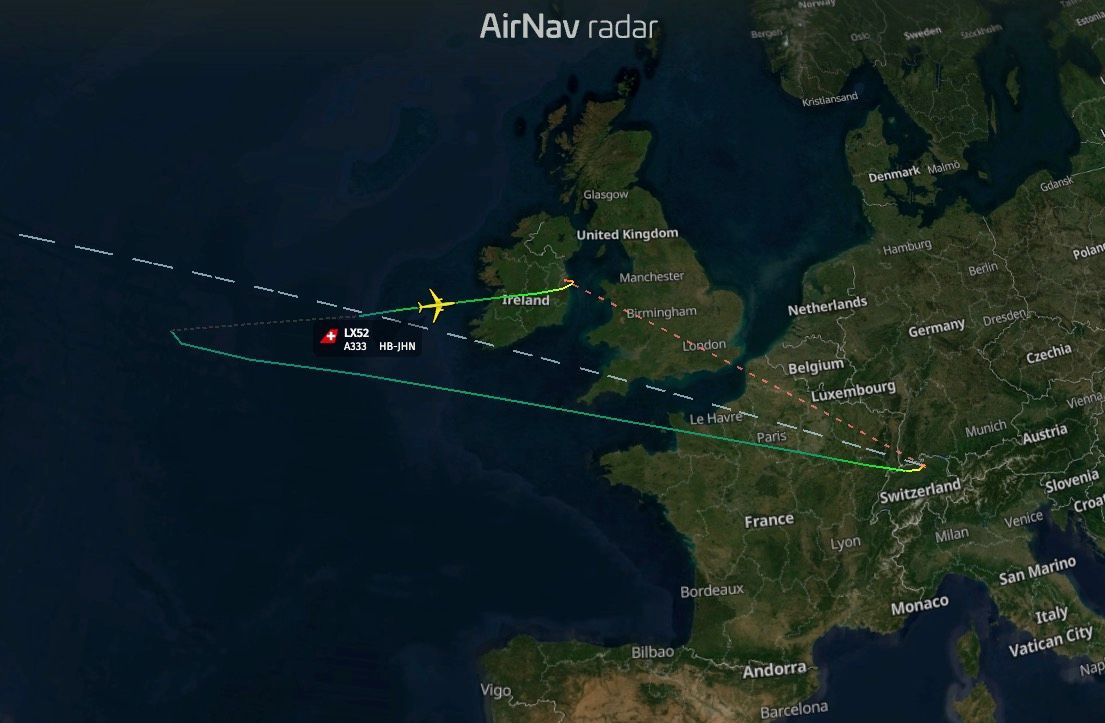
Pax Sentinel - Mayday Over Atlantic Forces SWISS Flight to Dublin
Swiss International Air Lines Flight LX52 declared a mid-Atlantic emergency on Sunday, August 9, 2026, after a passenger’s portable power bank emitted smoke, forcing an unscheduled landing in Dublin. The widebody aircraft, which is a large passenger aircraft with two cabin aisles, was carrying 206 passengers and 12 crew members from Zurich to Boston when the incident occurred. This emergency diversion represents the second lithium-battery incident on a SWISS aircraft in less than two weeks. The Dublin landing follows a previous transatlantic emergency on Flight LX16 in late July, when a [crushed charging case triggered a transatlantic emergency landing](/en/article/CbFj6mMP_crushed-charging-case-triggers-transatlantic-emergency-landing) after slipping into a motorized business class seat frame. Additionally, parent company Lufthansa experienced a separate cabin-odor emergency on August 6, 2026, when Flight LH573 made an emergency landing in Brazzaville, Republic of the Congo. The sequential emergencies have drawn criticism from passenger safety advocates, who note that the group's onboard battery regulations are failing to prevent thermal events. Emergency Over the Atlantic Flight LX52 departed Zurich Airport at 6:22 p.m. local time, climbing to a cruising altitude of 38,000 feet. Approximately three hours into the journey, while positioned roughly 660 nautical miles west-southwest of Dublin, the flight crew detected a buildup of smoke in the passenger cabin. The pilots immediately declared a "Mayday" emergency, the international radio distress signal indicating grave and imminent danger. While air traffic controllers in Ireland initially prepared emergency ground services at Shannon Airport, the pilots chose to divert directly to Dublin Airport. The Airbus A330-300, registered as HB-JHN, landed safely on Runway 28L in Dublin at 10:07 p.m. local time. Emergency fire personnel met the widebody jet on the taxiway to inspect the cabin, where they confirmed that a portable power bank had overheated. SWISS representatives said that all 218 people on board disembarked without injuries. Passengers were accommodated in local hotels overnight and scheduled for rebooking on subsequent flights to Boston. The 13-year-old aircraft remains grounded in Dublin to undergo comprehensive safety checks before performing a positioning flight, which is an unscheduled flight conducted solely to relocate an aircraft, back to Switzerland. A SWISS spokesperson, Ms. Meike Fuhlrott, said that technical specialists are inspecting the airframe. Ms. Fuhlrott added that the carrier expects to return the jet to service once cleared by maintenance. Diverting Over Central Africa Only three days prior, on August 6, 2026, Lufthansa Flight LH573 was forced to land in Central Africa due to a distinct cabin odor. The flight, operated by a Boeing 747-8 carrying 363 passengers and 16 crew members, was en route from Johannesburg to Frankfurt. The flight crew declared a general emergency by transmitting transponder code 7700 while cruising at 34,000 feet over the Democratic Republic of the Congo. The pilots initiated a rapid descent toward Maya-Maya Airport in Brazzaville, the capital of the neighboring Republic of the Congo. Lufthansa confirmed that an "indefinable smell" prompted the diversion, which left hundreds of passengers stranded in Brazzaville overnight. The airline dispatched a recovery Boeing 747-8 from Frankfurt on August 7 to retrieve the stranded travelers, who arrived in Germany 26 hours behind schedule. Fleet-Wide Safety Questions The rapid succession of cabin smoke and odor incidents across the Lufthansa Group has intensified scrutiny of its operational safety. These events occur despite strict guidelines introduced in January 2026, which ban passengers from actively using or charging portable power banks on board. Under these regulations, passengers are permitted to carry a maximum of two power banks, but they must remain in hand luggage stowed under the seat. The airline group prohibits stowing electronic devices in overhead bins or checked luggage, where an active thermal fire cannot be quickly accessed. However, critics note that tight ground schedules and reduced cabin crew sizes undermine the effective enforcement of these rules. The group's habit of minimizing safety risks to avoid regulatory scrutiny was previously documented when a [SWISS crew executed an exemplary emergency landing after cabin smoke](/en/article/DDnhdifB_swiss-crew-executes-exemplary-emergency-landing-after-cabin-smoke) in Maine. In that incident, the SWISS public relations department pressured safety databases and independent publishers to replace reports of a "cockpit fire" with "cabin smoke." A similar pattern of corporate minimization was seen when a [federal accident report confirmed a deformed airframe and underreported injuries](/en/article/oPA5y4Yd_accident-report-confirms-deformed-airframe-and-underreported-injuries) on a Lufthansa Boeing 787-9 in Frankfurt. These incidents are compiled in Table 1 below, demonstrating a series of fleet-wide safety disruptions over a short period. As passenger electronics become more ubiquitous, the carrier's reliance on consumer compliance rather than structural design improvements continues to face criticism. | Date | Flight | Route | Aircraft | Declared Emergency | Diversion Airport | Stated Cause | | --- | --- | --- | --- | --- | --- | --- | | July 27, 2026 | LX16 (SWISS) | Zurich – New York | Airbus A330-300 | Yes (7700) | Bangor, Maine (BGR) | Crushed earbud case | | August 6, 2026 | LH573 (Lufthansa) | Johannesburg – Frankfurt | Boeing 747-8 | Yes (7700) | Brazzaville, Congo (BZV) | Undefined cabin odor | | August 9, 2026 | LX52 (SWISS) | Zurich – Boston | Airbus A330-300 | Yes (Mayday) | Dublin, Ireland (DUB) | Power bank smoke | Table 1: Recent cabin smoke and odor incidents across Lufthansa Group fleets