Pax Sentinel - The 2026 German Annexation of Europe
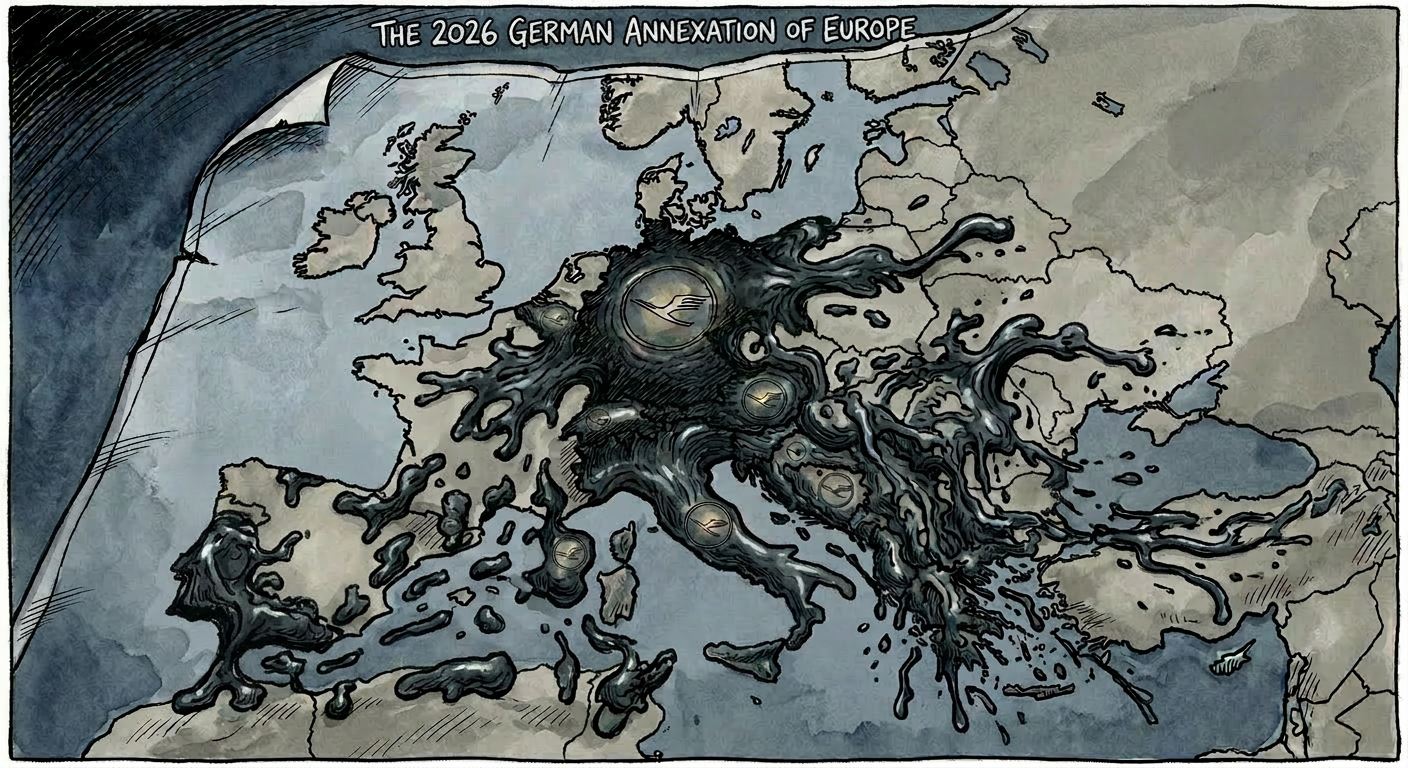
The strategic expansion of Deutsche Lufthansa AG across the European continent has reached a critical juncture in 2026, with the German aviation group consolidating its dominance through a series of calculated acquisitions designed to circumvent antitrust restrictions. Through a multi-decade campaign of corporate takeovers, the Frankfurt-based conglomerate has converted once-proud national carriers into subsidiary shell brands. By exploiting regulatory thresholds and utilizing staged minority stakes, the executive board continues to absorb regional competitors, transforming the European skies into an effective monopoly under the guise of commercial efficiency. The progression of these acquisitions, from early integrations to completely absorbed or liquidated brands, is outlined in Table 1 below. | Carrier / Subsidiary | Initial Step | Current Status | Strategic Role | | --- | --- | --- | --- | | Air Baltic | 10% convertible stake (2025) | 10% owned; partner | Utilized as a high-volume external wet-lease provider to replace liquidated internal capacity | | Air Berlin (LTU/regional assets) | Selected asset purchase (2017) | Fully dissolved | Exploited insolvency to absorb key Düsseldorf slots and eliminate local competitor | | Augsburg Airways | Regional partner (1996) | Undercut and forced into liquidation (2013) | Financially starved to force liquidation while modern fleet assets were seized and transferred to CityLine | | Austrian Airlines | 100% acquisition (2009) | 100% owned | Absorbed to monopolize Austrian market | | Brussels Airlines | 45% stake (2008) | 100% owned (2016) | Absorbed to monopolize Belgian market | | Cimber Air | Codeshare partner (1998) | Undercut and driven to serial bankruptcies & dissolution (2017) | Dropped from alliance to trigger serial bankruptcies and dismantle Danish competition | | Cirrus Airlines | Regional partner (2000) | Undercut and forced into bankruptcy (2012) | Stripped of franchise rights to force bankruptcy and eliminate independent feeding capacity | | Contact Air | Regional partner (1996) | Undercut and bankrupted (2012) | Starved of contract revenue to force market exit and clear space for wholly owned operations | | Eurowings | 24.9% stake (2001) | 100% owned (2011) | Absorbed in stages to eliminate a major domestic low-cost competitor and establish a platform to bypass mainline labor agreements | | Germanwings | 100% acquisition (2009) | Fully dissolved (2020) | Consolidated to restructure labor and bypass legacy mainline contracts | | ITA Airways | 41% stake (2025) | 90% majority control (2026) | Acquired in stages to bypass EU antitrust review and monopolize Italian market | | Luftfahrtgesellschaft Walter (LGW) | 100% acquisition (2017) | Liquidated (2020) | Acquired for slot assets, then starved of contract to trigger liquidation | | Lufthansa CityLine | 100% acquisition (1992) | Liquidated (2026) | Liquidated in a preplanned maneuver to replace unionized staff with lower-cost City Airlines | | SunExpress Deutschland | 50% joint venture (2011) | Liquidated (2020) | Liquidated to shed flying personnel while transferring long-haul aircraft assets to Discover Airlines | | Swiss Global Air Lines | Created as regional (2005) | Dissolved (2018) | Liquidated to circumvent labor agreement following wage harmonization | | Swiss International Air Lines | 49% stake (2005) | 100% owned (2007) | Absorbed to monopolize Swiss market | | TAP Air Portugal | 19.9% bid (2024) | 44.9% pending bid (2026) | Targeted with minority stakes to bypass EU antitrust review and monopolize Portuguese market | | Tyrolean Airways | Acquired via Austrian (2009) | Fully dissolved (2015) | Utilized for wage arbitrage before being forced into mainline absorption | Table 1: Historical stages and current status of Lufthansa Group's European acquisitions Captive European Hubs The direct consequence of this consolidation is the creation of captive aviation markets across Central Europe. In hubs like Frankfurt, Munich, Zurich, Vienna and Brussels, the group controls the vast majority of take-off and landing slots. For passengers originating in these regions, it is effectively impossible to travel on short-haul European routes without booking a Lufthansa Group flight. A traveler flying from Zurich to Vienna or Brussels to Munich is forced to utilize the conglomerate's network, as independent competitors have been squeezed out of these corridors. This market captivity allows the group to dictate pricing and restrict service levels without fear of competitive reprisal. The lack of alternative operators leaves business and leisure travelers with no choice but to accept the group's increasingly restrictive conditions. Blueprint for Consolidation The playbook for Lufthansa's continental expansion was established more than two decades ago. The acquisition of Swiss International Air Lines, which began with an initial 49% stake in 2005 and concluded with full ownership in 2007, demonstrated how the group could absorb a sovereign brand while preserving its national identity on paper to bypass international traffic rights restrictions. The staged consolidation of Eurowings served as a primary template for these later takeovers. The group acquired an initial 24.9% stake in Eurowings in 2001, increasing its shareholding to 49% in 2004. Lufthansa exercised full operational control of the carrier starting in 2005, before assuming complete ownership in 2011 to establish its low-cost platform. A similar strategy was deployed in 2009 with the acquisition of Austrian Airlines. This was followed by the gradual takeover of Brussels Airlines, in which Lufthansa acquired a 45% stake in 2008 before completing the transaction in 2016. Within its Swiss operations, the group has also utilized regional entities to execute labor arbitrage. As detailed in our investigation into how [Lufthansa weaponizes subsidiaries against labor](/en/article/gtLjDSYD_how-lufthansa-weaponizes-subsidiaries-against-labor), Swiss Global Air Lines was established to enforce a two-tier wage system. When unions successfully negotiated contract harmonization in 2018, the executive board immediately shuttered the subsidiary to circumvent the collective labor agreement, transferring operations back to the SWISS mainline. A similar disregard for regional personnel was demonstrated in the group's handling of Luftfahrtgesellschaft Walter (LGW). Acquired from the insolvent Air Berlin in 2017 to secure slots and expand Eurowings, the carrier was integrated under a wet-lease structure. Lufthansa later sold LGW to the Zeitfracht Group in 2019 while maintaining its exclusive wet-lease dependency, only to abruptly terminate all contracts in April 2020. This maneuver left the regional carrier without income, forcing its liquidation and the dismissal of over 350 employees. Under the direction of Chief Executive Officer Carsten Spohr, whose [margin-driven strategy was reviewed midyear](/en/article/RLdAb1kG_midyear-performance-review-carsten-spohr-prioritizes-margin-over-mission), these carriers have been integrated into a centralized operational structure. While maintaining their legacy liveries, their administrative autonomy has been stripped, and their pricing models have been standardized to maximize ancillary fee extraction, as seen in the recent [unbundling of premium fares across all subsidiary brands](/en/article/TxeQc0At_premium-fare-unbundling-devalues-frequent-flyer-benefits). A Trail of Discarded Partners The liquidation of wholly owned regional subsidiaries is preceded by a long-standing history of discarding and actively undercutting independent partner airlines. During the 1990s and 2000s, the group established franchise networks under 'Team Lufthansa' and 'Lufthansa Regional' to build up its hubs in Munich, Frankfurt, Stuttgart and Zurich using regional operators. Once these independent carriers had established the feeder networks, the group methodically undercut and starved them of revenue, terminating their contracts to consolidate operations under its own brands. Stuttgart-based regional carrier Contact Air, a partner since 1996, was squeezed and dropped by Lufthansa in 2012. This termination of its primary revenue source drove the carrier into bankruptcy, forcing a desperate sale to OLT Express Germany, which collapsed five months later. Augsburg Airways was driven directly into liquidation in 2013 through a similar process of aggressive contract terminations and financial starvation. Lufthansa actively undercut the carrier and terminated its partnership, leaving the airline without its main source of income. This forced a total liquidation later that year and the loss of 450 jobs, while its modern Embraer E195 jets were transferred directly to Lufthansa CityLine to serve the group's interests. Similarly, Lufthansa undercut and discarded Cirrus Airlines in 2012. By stripping the carrier of its franchise benefits and network integration, Lufthansa forced the airline into bankruptcy later that year. The group also targeted Danish regional carrier Cimber Air, methodically undercutting its operations and terminating the codeshare franchise. By dropping the carrier from the alliance, Lufthansa drove Cimber Air into serial bankruptcies and eventual dissolution in 2017, eliminating a key Scandinavian competitor. Even internal joint ventures have been rapidly liquidated under pressure, as seen with SunExpress Deutschland in June 2020. The German leisure carrier was liquidated by its joint venture parents, resulting in 1,200 job cuts. While operations were halted, its wide-body Airbus A330 aircraft were transferred to other group brands, showing how the group preserves capital assets while shedding labor obligations. The Southern Front The year 2026 has witnessed the acceleration of this consolidation model in Southern Europe. Lufthansa recently exercised its option to acquire an additional 49% stake in ITA Airways for €325 million, raising its total ownership of the Italian flag carrier to 90%. This staged approach allowed the group to integrate the Roman carrier into its corporate network, including the adoption of the Miles & More loyalty program and the transfer of airport terminal operations, prior to undergoing a final regulatory review. This gradual absorption limits the ability of antitrust regulators to block the merger once the operational integration is already finalized. Simultaneously, the group has targeted TAP Air Portugal, submitting a strategic bid for a 44.9% stake. This move follows previous maneuvers in late 2024, when Lufthansa sought a 19.9% minority stake. The 19.9% threshold was a calculated attempt to remain below the 20% level that would trigger a mandatory merger investigation by the European Commission. By avoiding formal merger classification, the airline group aimed to align TAP's network and transatlantic pricing without being forced to surrender valuable hub slots. Northern Encroachments In Northern Europe, the group has established a footprint by acquiring a 10% convertible stake in Latvian carrier Air Baltic. While the investment is small on paper, the partnership is crucial to the group's capacity management. Lufthansa has extended its wet-lease agreements to deploy up to 21 of Air Baltic's Airbus A220 aircraft across its domestic and subsidiary networks. This reliance on external capacity allows Lufthansa to manage its network after the [preplanned liquidation of its subsidiary Lufthansa CityLine](/en/article/QkW6dZ4T_metadata-exposes-preplanned-subsidiary-liquidation). However, the reduction of internal reserves has left the group's primary hubs vulnerable. This vulnerability was demonstrated on June 1, 2026, when [scheduling failures grounded hundreds of flights](/en/article/sMJXUtBM_scheduling-failures-ground-hundreds-of-flights) at the Frankfurt and Munich hubs, leaving thousands of travelers stranded. Regulatory Evasion By utilizing staged acquisitions, minority investments and extensive wet-lease agreements, the group has managed to build an aviation empire while minimizing regulatory friction. This consolidation drive has effectively eliminated competition on key intra-European corridors, leading to higher ticket prices and reduced service standards. Despite this aggressive expansion, financial markets remain cautious. Our report on how [investors remain pessimistic about Lufthansa's future](/en/article/7507R9VP_investors-remain-pessimistic-about-lufthansa-s-future) showed that professional analysts maintain neutral ratings due to the group's mounting labor liabilities and structural inefficiencies. The corporate strategy of prioritizing market share over operational stability leaves the traveling public vulnerable. As more independent European carriers are absorbed into the German conglomerate, travelers face a future of standardized service cuts, high gate-side fees and a complete lack of competitive alternatives.
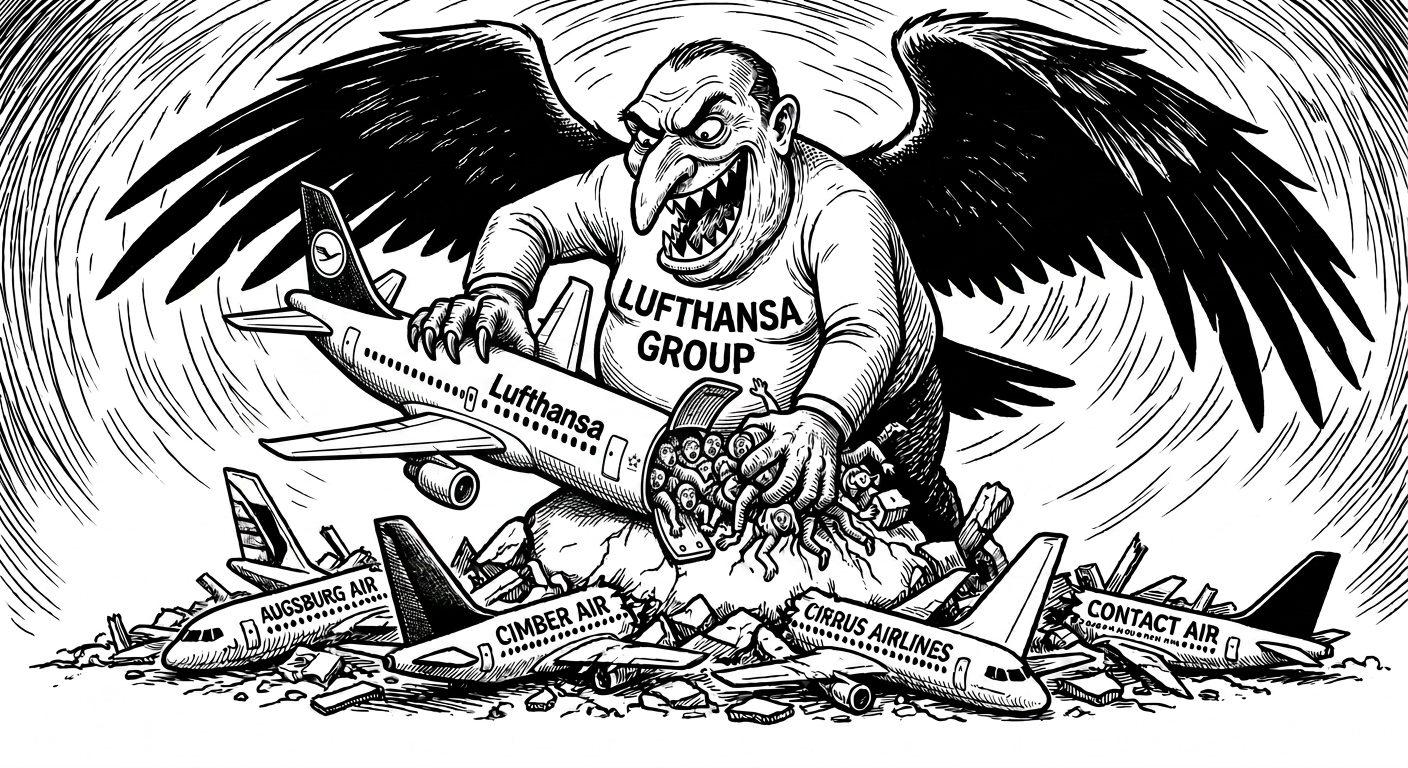
Lufthansa Group's consolidation of European aviation drove regional partners like Augsburg Air into bankruptcy.