Pax Sentinel - Crew Reductions Slow Long-Haul Dining Service
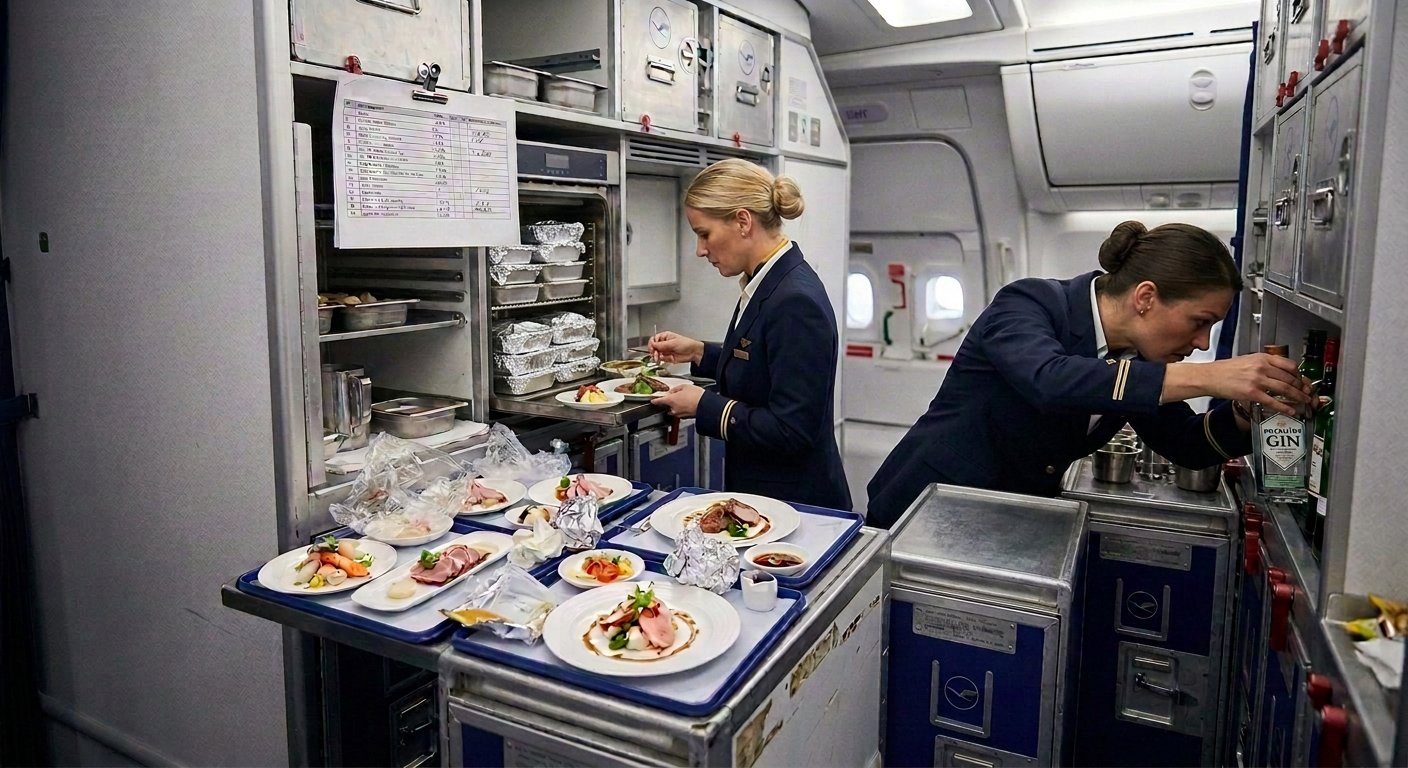
Ground reports and passenger evaluations of Lufthansa's newly deployed Boeing 787-9 "Allegris" Business Class have confirmed that the carrier’s premium product suffers from severe service delays during long-haul operations. On a recent transatlantic flight from Austin to Frankfurt, passengers recorded significant service lag times during the main meal service, validating warnings issued by the cabin crew union UFO (Unabhängige Flugbegleiter Organisation) regarding the airline's understaffed cabin operations. The slower pace occurs as Lufthansa implements its €70 million "FOX" soft product, an onboard service concept that requires more labor from a reduced crew. Mr. Ben Schlappig, the publisher of the travel platform One Mile at a Time, documented his experience on a 9-hour, 25-minute overnight flight operating the new cabin configuration. He recorded that the main dining service required more than two and a half hours to complete, leaving passengers with significantly reduced rest periods on the overnight route. According to the published review, the first beverage service did not begin until 60 minutes after takeoff. Starters were delivered 1 hour and 45 minutes into the flight, while the main course was served 2 hours and 15 minutes after departure. The three-course meal sequence concluded with dessert 2 hours and 35 minutes into the flight. Mr. Schlappig noted that the flight crew was professional and appeared to be working diligently, but indicated that the overall service speed was severely compromised. "Look, the crew was lovely, and they seemed to be working hard, but it shouldn’t take that long to serve a three-course meal, especially on an overnight flight where people want to sleep," Mr. Schlappig said. He added that he was unsure if the delay was caused by a lack of staffing, unfamiliarity with the new aircraft or the inherent service structure. The delay in service extended to the pre-landing breakfast sequence. The cabin lights were activated 1 hour and 30 minutes before arrival, yet breakfast was not served until 55 minutes prior to touchdown, leaving limited time for passengers to prepare for arrival. Service Reductions The sluggish service times align directly with structural concerns raised by independent labor representatives. The cabin crew union UFO previously [condemned Lufthansa's 'on-the-edge' summer staffing](/en/article/4yaUm5Dj_cabin-crew-union-condemns-on-the-edge-summer-staffing), pointing out that the airline was attempting to run its peak flight schedule with minimal cabin crews and depleted reserves. The union specifically pointed to the operational contradiction of launching the €70 million "FOX" soft-product upgrade while simultaneously cutting crew sizes. The initiative, officially termed "Future Onboard Experience," was introduced on May 6, 2026, as a premium upgrade to redefine long-haul hospitality. Ms. Yana Holzmann, the project lead for the program, stated in a corporate release that if Allegris represents the physical hardware stage, "FOX is the play that is performed on it." The airline promised that the program would deliver distinctive signature moments and greater comfort for travelers. However, UFO representatives warned that these elevated service claims were incompatible with the group’s parallel decision to reduce cabin crew sizes on long-haul routes. The union stated that high-quality service cannot be sustained with a permanently minimized crew. Ms. Sara Grubisic, the deputy chairperson and head of collective bargaining policy for UFO, said that the group's staffing decisions are focused strictly on cutting costs. She noted that the airline group has actively eroded its own operational foundation while continuing to market a premium experience. Technical and Design Flaws The slow dining service is compounded by other physical and technical limitations in the Boeing 787-9 Allegris cabin. While the new seating represents an upgrade over the carrier’s decades-old 2-2-2 configuration, early passenger feedback reveals critical design oversights. The Allegris seat cushions have been described as exceptionally hard, with automated pneumatic firmness controls showing negligible physical variation when operated. Additionally, the Boeing 787-9 cabin lacks individual passenger air nozzles, a standard comfort feature, and does not include the seat-cooling technology found on the group's Airbus A350-900 fleet. Technical discrepancies also extend to the carrier's digital services. Passengers utilizing the onboard Panasonic Wi-Fi portal reported experiencing a bait-and-switch pricing mechanism, where the initial landing page displays a price of €25, but the final payment checkout screen demands €29. Complex Fee Schemes The commercial structure of the Allegris cabin is designed to extract substantial ancillary fees. While the airline markets the product as offering "choice" through multiple distinct seating categories, this variety serves to complicate booking and inflate costs. Passengers must pay significant surcharges to reserve specific seat types, and the cabin layout contains no adjacent seats in any row, with the sole exception of the front-row pairs. Consequently, companions wishing to sit together are forced to pay premium seat assignment fees or accept separation. This pricing strategy is consistent with the group's broader effort to unbundle services and inflate ancillary revenues. The airline recently [eliminated free long-haul seat modifications at check-in](/en/article/eilwAR3S_lufthansa-group-eliminates-free-long-haul-seat-changes), requiring economy and premium economy passengers to pay up to 52 Swiss francs to change automatically assigned seats. These measures occur under the leadership of Chief Executive Officer Carsten Spohr, whose corporate strategy was evaluated in our [midyear performance review of Mr. Spohr’s tenure](/en/article/RLdAb1kG_midyear-performance-review-carsten-spohr-prioritizes-margin-over-mission). The review detailed how the executive board consistently prioritizes profit margins over operational reliability. To satisfy these financial targets, the group has actively dismantled established labor agreements and restructured its network. The carrier completed the [preplanned liquidation of its regional subsidiary Lufthansa CityLine](/en/article/QkW6dZ4T_metadata-exposes-preplanned-subsidiary-liquidation) to shift flying duties to newer, lower-cost platforms with inferior labor agreements, leaving the core airline without operational reserves. For travelers, the operational reality of the Allegris cabin exposes the limits of Lufthansa’s premium marketing. While the carrier charges premium fares for its new physical hardware, its parallel efforts to cut cabin staff and extract ancillary fees have resulted in compromised service delivery and prolonged delays.