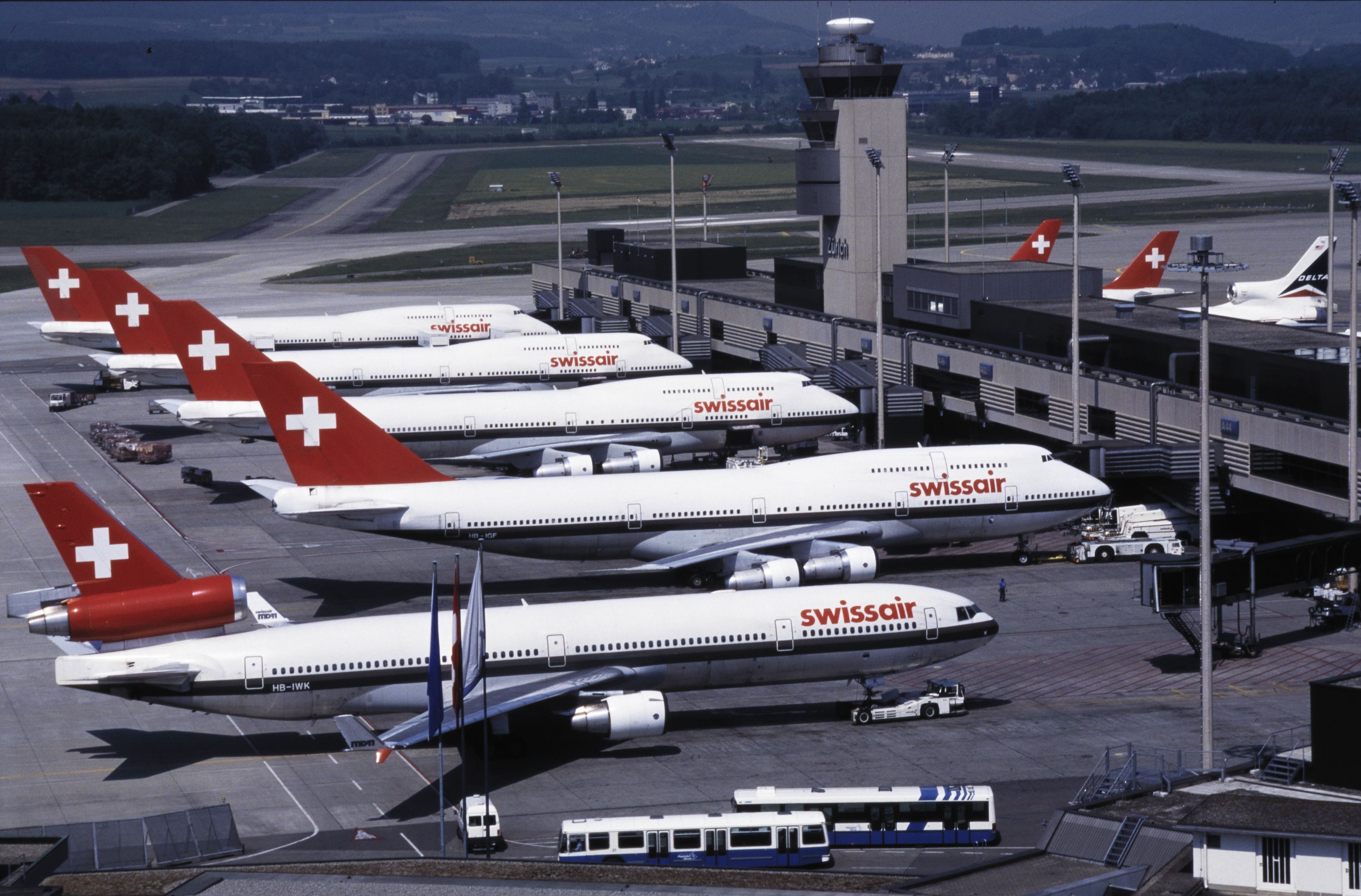
Pax Sentinel - Swissair Collapse Marks 25 Years: The Unraveling of a National Symbol
October 2 marked 25 years since Swissair, once considered a national symbol of Switzerland and nicknamed the "Flying Bank," ceased commercial flight operations. An announcement at Zurich Airport informed thousands of stranded passengers that the airline was unable to continue its schedule, triggering a financial and operational crisis that reverberated across the global aviation sector. The grounding occurred at 4:17 PM on October 2, 2001, following hours of delays and uncertainty. The airline informed media by fax at 3:45 PM that it was suspending flights with immediate effect, citing an acute liquidity shortage and an inability to purchase fuel. Contemporary dispatches from [The Guardian](https://www.theguardian.com/business/2001/oct/02/theairlineindustry1) and [BBC News](http://news.bbc.co.uk/2/hi/business/1574658.stm) recorded that British airport operator BAA had impounded two Swissair aircraft at London Heathrow Airport over unpaid charges, while kerosene suppliers demanded immediate physical cash on airport aprons. Approximately 39,000 travelers worldwide found themselves without onward travel, many with checked luggage already in transit. Aggressive Expansion and Strategic Miscalculation The origins of Swissair's demise trace back to Switzerland's 1992 rejection of European Economic Area (EEA) membership. This decision denied the airline free access to the liberalized European market, necessitating a reorientation of its commercial strategy. Philippe Bruggisser, then CEO, initiated the "Hunter Strategy" in 1997, aiming to acquire numerous smaller airlines to achieve critical mass and circumvent market access limitations. To support this corporate expansion, the company restructured in 1997 under the SAirGroup umbrella holding, establishing distinct divisions for airline operations, ground handling, catering and logistics. This strategy, however, resulted in the acquisition of unprofitable carriers such as Sabena of Belgium and Volare of Italy. European Union regulations prevented Swissair from exercising majority operational control over Sabena, rendering Swissair contractually liable for the Belgian airline's losses without corresponding executive management influence. The financial drain from these acquisitions contributed to the rapid deterioration of Swissair's financial health, leading to the failure of the "Hunter Strategy." Mr. Bruggisser was compelled to resign. Moritz Suter briefly assumed leadership in early 2001, followed by Mario Corti after the resignation of the entire board of directors, led by Eric Honegger. Mr. Corti faced significant pressure from Swissair's primary lenders, UBS and Credit Suisse. While commercial banks announced the "Project Phoenix" plan to transfer operations to regional unit Crossair, the agreement excluded bridge liquidity for Swissair mainline flights. Crew corporate credit cards were canceled, stranding personnel abroad alongside passengers. Despite attempts to secure government assistance, the federal government initially declined an unconditional guarantee on September 29. Crossair, under André Dosé, took over Swissair's flight operations on October 1, 2001. The following day, October 2, the official grounding occurred. Although reduced operations resumed temporarily due to a 450 million Swiss franc emergency loan, the last scheduled Swissair flight, SR145 from São Paulo, landed on April 1, 2002, marking the end of its 71-year history. Post-collapse, a lengthy process ensued to address the largest corporate failure in Swiss history. Despite charges against 19 former managers and board members, all were acquitted. The financial settlement was not finalized until December 2025, 24 years after the grounding, with the removal of the holding company SAirGroup from the commercial register. Grounding Controversy An investigation by the Zurich branch of Ernst & Young indicated that between CHF 50 million and CHF 123 million may have been available to Swissair on the day of the grounding, contradicting management's public statements of only CHF 14.5 million. André Dosé, the former CEO of Crossair and the first CEO of the successor airline, Swiss International Air Lines, stated in 2004 that the grounding was not necessary. Mr. Dosé reiterated this view in 2021, suggesting former CEO Mario Corti and CFO Jacqualyn Fouse may have misjudged the available funds. Mr. Corti vehemently rejected these assertions, maintaining that uncommitted funds were legally sequestered by lenders. Modern Industry Implications The grounding raises questions regarding what modern aviation can learn from the collapse of a carrier once regarded as unassailable. The primary distinction between then and now lies in corporate structure: Swissair pursued an aggressive, standalone expansion that exceeded its balance sheet, whereas contemporary Swiss International Air Lines operates buffered within the broader Lufthansa Group. Yet similarities persist in operational vulnerability. Centralized group control shields individual airline brands from isolated liquidity shocks, but local management loses autonomy over capacity and network planning. These internal tensions were visible as [Swiss pilots intensified contract disputes](/en/article/D210ipej_swiss-pilots-intensify-contract-dispute) over leisure scheduling and outsourcing to wet-lease operators. Furthermore, as Pax Sentinel reported on how [monopoly control fuels surging Swiss airfares](/en/article/ZdTbQ5O7_monopoly-control-fuels-surging-swiss-airfares), regional market concentration often leaves consumers exposed to elevated fares and diminished route competition when legacy groups absorb regional competitors.