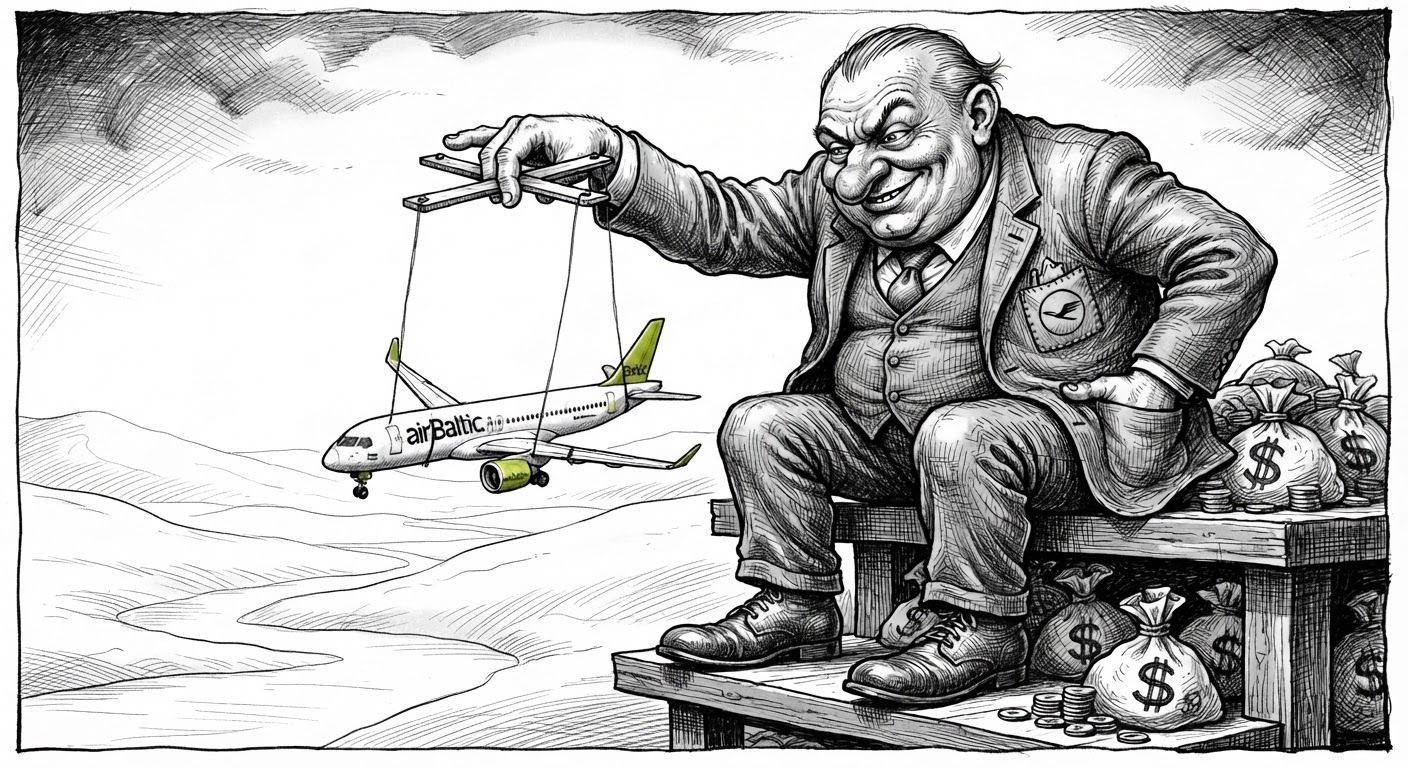
Pax Sentinel - How Manipulation and Outsourced Risk Seal airBaltic's Fate
When airBaltic filed for Chapter 11 bankruptcy protection in a United States court, seeking to restructure approximately $583 million in funded debt and finance lease liabilities, the carrier's corporate narrative cited engine durability flaws, lost Eastern European transit routes, and closed sovereign credit lines as contributing factors. However, the structural unraveling of the Latvian flag carrier reflects a more deliberate commercial dynamic, with a direct governance question remaining unanswered by Lufthansa Group, as detailed by industry analyst Addison Schonland. Yet the structural unraveling of the Latvian flag carrier reflects a more deliberate commercial dynamic. For years, the Lufthansa Group utilized the Riga-based carrier as an outsourced operational buffer, offloading capacity risks while extracting cheap regional feed. When financial pressures mounted on the supplier, the German conglomerate exercised calculated restraint, refusing capital injections while positioning itself to absorb market share across Central and Northern Europe. The Wet-Lease Dependency The foundation of airBaltic's fiscal vulnerability was built directly into its commercial relationship with Frankfurt. Under extensive wet-lease agreements, where one airline supplies aircraft, complete flight crews, maintenance and insurance to another, airBaltic operated up to 21 Airbus A220 aircraft across the German group's network. In 2025 alone, wet-lease flying generated €157 million for airBaltic, representing more than 20 percent of its total corporate turnover. The flying provided essential peak-season capacity for Lufthansa, SWISS, Austrian Airlines and Brussels Airlines. This arrangement allowed the German group to bypass internal crew shortages and suppress labor expenses across its mainline hubs without incurring long-term capital commitments. For airBaltic, however, the model required massive fleet expansion financed by expensive debt. The carrier doubled down on aircraft commitments to service foreign hubs, leaving its balance sheet exposed to interest rate swings and engine maintenance groundings. Strategic Boardroom Inaction The asymmetry deepened in early 2025 when the Lufthansa Group purchased a 10 percent equity stake in airBaltic for €14 million, securing a seat on the carrier's supervisory board. This seat is held by Dr. Alexander Feuersänger, who concurrently serves as Lufthansa Group’s Senior Vice President of Fleet Management and a board member of German Operating Aircraft Leasing (GOAL), an aircraft lessor with a leasing relationship to airBaltic. Industry analysis by Addison Schonland raised a direct governance question regarding recusal practices on airBaltic's board when financing and fleet decisions might touch Lufthansa's or GOAL's interests; Lufthansa Group has not provided a response to this query, stating it does not plan to increase its stake in airBaltic, while airBaltic offered "no comment on Company internal matters." Rather than providing strategic security, the minority holding gave the German conglomerate direct oversight of airBaltic's commercial books and operational planning while committing minimal corporate capital. When the Latvian government barred further unconditional bailouts and airBaltic faced prohibitive interest burdens on its high-yield notes, Lufthansa leadership declined to extend emergency credit lines or backstop debt refinancing. This hands-off posture aligned with the corporate consolidation goals articulated by Chief Executive Officer Carsten Spohr, who previously acknowledged that [market consolidation and carrier elimination remain core expansion objectives](/en/article/11LwoUEW_spohr-confesses-to-market-consolidation-monopolization) for the group. By withholding financial support from a dependent partner, central management accelerated the carrier's liquidity crisis. The subsequent [Chapter 11 bankruptcy filing in New York](/en/article/U2sz13xq_airbaltic-files-for-chapter-11-bankruptcy) forced airBaltic into sweeping fleet contractions and debt concessions. Operational Risk Acknowledged The clearest public acknowledgment of operational risk within the Lufthansa Group due to airBaltic's situation came not from the holding company, but from its subsidiary, SWISS. Mr. Dennis Weber, SWISS's Chief Financial Officer, stated publicly that "professional risk management" necessitated "examining other options to potentially replace capacity that could fall away." This indicated active contingency planning by SWISS, which wet-leases up to 10 airBaltic aircraft to cover its own engine and pilot shortages, a gap that has persisted since 2022. This proactive risk assessment contrasts with the parent company's public silence on the strategic implications of airBaltic's restructuring, as reported by AirInsight. Consolidating Regional Control The resulting fallout follows a familiar pattern in European aviation, aligning with the group's documented [blueprint for consolidation](/en/article/kmQ0TV94_the-2026-german-annexation-of-europe). As [Latvia rejected a fresh bailout while airBaltic slashed its fleet](/en/article/UN2rFswg_latvia-rejects-fresh-bailout-as-airbaltic-slashes-fleet-target), the regional carrier dismantled order backlogs for 40 aircraft and returned surplus leased jets. With airBaltic forced to shrink its standalone network, passenger traffic across the Baltic corridor becomes increasingly dependent on the Lufthansa Group's central transfer nodes in Frankfurt, Munich, Vienna and Zurich. This dynamic leaves captive travelers with fewer regional choices and higher fares, even as [plunging operating profits prompt further passenger fare hikes](/en/article/YcKwfI86_plunging-operating-profits-prompt-further-passenger-fare-hikes) across the group's network. By treating regional suppliers as disposable operational cushions, the conglomerate insulates its boardroom from the costs of fleet overexpansion while extracting commercial advantage from the resulting distress.